|

Top of page: Nigel Steward rakes us through the build of a modern National Hot Rod Bottom of page (scroll down or click HERE): National Hot Rods History & Heritage
We picked up the chassis from the new Ludlow Motorsports workshop in Aldershot on Thursday 16th Feb. Friday evening was spent welding some small brackets back onto the chassis before painting, which was to take place on Saturday.
Early Hot Rods were built using a donor vehicle, normally an insurance write off; the car would be stripped and a roll cage would be fitted inside the body of the car. Well, things have moved on since those times, although if you look at a modern National Hot Rod you will still see some throwbacks to the early days, you will see some of these later in the build.
The chassis of a modern National Hot Rod is constructed completely of tubular steel of varying thickness and diameter. Strict rules specify the roll cage spec. and certain aspects of the chassis, but some parts are still left to the constructor’s ingenuity. The chassis - or spaceframe as it is sometimes called - is the backbone of the car. It supports the engine and drivetrain, as well as all the suspension. Not all the chassis’ are the same, even from the same constructor. The chassis has to fit snugly inside the bodyshell, so a Tigra chassis would be different to a Corsa chassis etc.
We got the chassis back in the workshop on Monday evening and started the re-assembly process. First thing to go in was the oil tank, my engine runs what is known as a dry sump system; the oil is stored in this tank and pumped round the engine by an external pump that is fitted to the side of the engine. This type of oil system is generally thought to be more suited to the hard cornering and braking involved in racing. There are two schools of thought though, and about 30% of the current cars use a wet sump system as found on your road car: the oil sits in the sump and is pumped around the engine by an internal pump, thus saving weight and money, no need for an external pump, oil tank, or extra plumbing.
Next job was to check the clutch. We run a full race clutch with sintered bronze plates, much more hard wearing and stronger than the clutch on your road car. A race clutch works just like an on/off switch and hardly any slippage takes place, hence you see many a mechanic stall the car when first driving round the pits or on a parade lap... The clutch was okay, so on it went.
Once the clutch was on, the gearbox was then fitted to the engine. The gearbox is a Ford Type E as fitted to 1970's or 80's Capris and Cortinas, and has been used in Hot Rods for many years - still most cars are fitted with this type of gearbox. It’s not standard though, it’s fitted with different ratios: 1st gear is higher than standard allowing for faster starts. This is followed by 2nd and 3rd gears, whose ratios are really close together, giving a choice of racing gear with 400 revs between the two. The gearbox is fitted with a 4th gear but it’s rarely used, and of course, there’s a reverse gear in there as well. Not only are the ratios changed, but the gears in the gearbox are “straight cut”, stronger and less power sapping than the standard gears which are cut at an angle to lower noise and vibration. Becoming more common nowadays is the purpose built racing gearbox with sequential gear change; you just move the gear lever back to change up and forward to change down. These boxes also have the added advantage of having gears that are easy to change thus allowing more fine tuning of gearing to suit track conditions etc.
The engine is a Ford Zetec 16v 2 litre unit as fitted in 90’s Mondeos. It’s still fairly rare in National Hot Rods, with the majority of cars fitted with a similar Vauxhall engine. The engines produce about 100 more horsepower than when they were fitted in a road car. Modifications include: new pistons, steel con rods, race camshafts and dry sump system. Fuel injection is currently not allowed in National Hot Rods because of the extra expense and the higher fuel pressure causing safety concerns, so the engines are fitted with two Weber carburettors - providing another link with early Hot Rods. With all the modifications the engines produce somewhere in the region of 220 to 240 bhp. Modern Hot Rod engines are far more reliable than their earlier counterparts, and you would expect to get over a year’s racing before seeking a rebuild. In fact, I’m sure there are some motors out there racing that haven’t been touched for two or three years.
 The engine was fitted into the chassis and work then started on fitting some of the other components. First to go in was the steering rack, a faithful old unit out of a mk1 or mk2 Escort; the internal components are changed to make the steering more responsive. At the other end of the car, the axle was fitted, another item that has been part of Hot Rods for many years. It’s a Ford “English” axle that was standard in Anglias, Escorts and some early Capri’s, and is the only style of rear axle allowed by the rules. The casings themselves are getting quite hard to find especially the wider Capri version so Chris Ludlow now manufactures these from scratch. A limited slip differential fits in the axle casing and transmits the power to the rear wheels. These come in different ratios to fine tune the gearing to different tracks - with 3.77 or 3.89 being used at Birmingham, Ringwood etc and a 3.54 being used at the longer tracks like Ipswich and Hednesford.
The axle is held in place in the chassis by a combination of linkages. On a road car, these linkages would have rubber bushings to smooth the ride and cut noise, not something that’s a problem on a race car so we use what’s commonly known as rod ends or rosejoints. These precision parts allow the suspension parts to move without any slop. The linkages are fully adjustable for length and have a selection of mounting holes to allow adjustment of their angle, thus affecting how power is transmitted to the ground. To hold the axle in place we also fitted the rear shock absorbers, full race items made by Penske in the USA and as far as I know unique to my car in Nationals. They are adjustable for damping force and ride height. On a road car you would normally have a separate spring and shock absorber but race cars tend to have the spring fitted to the shock like this, hence the term “coil over shock”.
Part Two: In part one we saw most of the major components get fitted back in the car but there’s still plenty of work left to do to get a National Hot Rod ready to race…
The work was done in no particular order; we just fitted what we wanted at the time, but all the time trying to remember things that needed to be fitted before other items, so we didn’t end up doing any job twice. One such item was the transponder, which fits safely behind the seat. This clever little box sends a signal to Race Control whenever my car passes over the start/finish line, providing the track has a cable buried under the surface.
 While the Transponder was being fitted by one person, work continued at the front end on fitting the oil cooler and pipes for the dry sump system. The oil cooler looks just like a little radiator; air passes through the fins and cools the oil before it returns to the engine. 
The full size radiator was fitted next, nothing special about this, it’s a standard Ford part from a diesel Transit and provides a good combination of being lightweight, and holding just enough water to keep a high revving, race tuned National engine cool. Sometimes too cool - and the winter meetings found us having to tape up the grill to keep the engine at operating temperature!
 Then the exhaust: made out of stainless steel by Ludlow Motorsport and far more important than you might think. The exhaust not only gets the gas out of the engine, but plays a major role in the tuning of the engine. 
The length of each pipe is critical, as is the configuration of the pipes. My exhaust is a 4-2-1 system, meaning that 4 pipes come out of the engine cylinder head and merge into 2 pipes for a while before merging into 1 pipe for the rest of its journey to the rear of the car. Some other cars might use a 4-1 system, meaning that 4 pipes come out of the engine and merge into 1 pipe straight away. The engine builder would normally specify the exhaust to be used. We also took the time to fit the new MS500 silencer which is mandatory for 2006.
Next item that we tripped over and so decided to fit, was the battery. It’s a heavy duty part made by Exide and is designed for repeated discharging and recharging. As Hot Rod races are quite short, we do not fit an alternator as your road car would have to charge the battery. An alternator would add weight and use up some of the engine power, so we just charge the battery before a meeting and a good quality battery will have enough power to start the car and run its few electronic items all meeting.
Whilst fitting the battery, we remembered to fit the fuel tank next, before the interior panels went in. The fuel tank is made out of aluminium and holds about 3½ gallons of Shell Optimax petrol, hopefully just enough to do 75 laps.
We would have liked to have fitted the front suspension next, but we were waiting for some parts, so we had to go ahead and start fitting the panels. The interior panels went in first; rules state that the fuel tank must be fitted behind a metal firewall to protect the driver in case of fire.
With the interior in place we started on fitting the exterior panels. Made to resemble a Vauxhall Corsa, these panels are made in a mould using layers of glass fibre and kevlar, the same material that is used in bullet-proof vests - five times stronger weight-for-weight than steel. The exterior panels on a modern day Hot Rod take the knocks far better than the original steel body panels used on early Hot Rods, and keep the car looking tidier for longer.
Before we could fit the aluminium tunnel that covers the gearbox and propshaft, we had to get the seat in place. This full race seat is made from kevlar by Sparco to FIA regulations. You will also see cars fitted with American-style aluminium seats that support the body at the ribcage; I just feel more comfortable with a seat that supports at the shoulders. The seat is securely bolted in the car at the bottom and at shoulder height.
 We thought we’d better fit the ignition module before we forgot, this item is commonly known as the “MBE Box” due to the fact it’s made by MBE and is the only ignition box allowed in National Hot Rods. The engine would not run without this little box, it controls the timing of the ignition and also acts as the rev limiter, cutting the spark off at 8000 revs. The boxes are sealed at the factory and come in two types, one for the Vauxhall engine and one for the Ford or Peugeot engine.
Getting there now! In part 3 we’ll finish the build and run through some of the procedures for setting up the suspension.
Part Three: In parts 1 & 2 the car went from a bare chassis to an almost complete National Hot Rod. Just a few more items to fit - and some setting up - and it’s ready to race.
 Once some parts had arrived for the front suspension we set about fitting it to the car. Modern Hot Rod front suspension is normally of the “double A-arm” type. This system uses two ‘A’ shaped links to connect the wheel hub to the chassis, and is very efficient at controlling the angle of the wheel as it moves up and down.
The same Penske 7500 dampers that are fitted to the rear are also used at the front. On my car they are fitted to the lower A-arm and pass through the upper A-arm before fitting to the chassis. Have a look round the pits though, and you will find shock absorbers fitted in all types of places. Some teams fit them to the upper A-arm, and some others use a linkage fixed to the lower A-arm to connect the shock absorber - which is mounted inside the chassis - to the wheel hub. This is called “inboard suspension”.
 With all the suspension now in place, we set about fitting the brakes. The front braking system consists of AP Racing 4-piston callipers, with AP Racing brake discs. The rear braking system is far less powerful, with Wilwood 2-piston callipers, and standard Ford Escort MK3 brake discs. The front and rear braking systems are set up independently with separate master cylinders. This is so drivers can adjust the brake balance to fine tune corner entry. Too much front brake, and the front will slide and the car will go straight on; too much rear brake, and the back will slide out and the car will go sideways. Castrol SRF racing brake fluid is used as the brakes get very hot during a race.
 The wheels and tyres go on next, Hoosier H12 slick tyres fitted to 3-piece aluminium wheels that are 10” wide and 13” in diameter.
Now that the car is complete we can fit the very last item, the rear spoiler. The reason this is left till last is quite simple, if we fit it any earlier we will be forever banging our heads on it! The jury is still out on whether a spoiler makes a National Hot Rod go any faster but at least it does a good job of holding the fin numbers on.
Just the setting up to do now, taking from an hour to a whole day depending on how thorough you want to be. All teams will probably use different methods to set up their cars; I’ll just run through what we do and the order that we do it.
We start off by filling the seat with weights to simulate the driver (someone sitting in the seat for hours could get very bored). It’s not essential that the driver’s weight is in the car - lots of teams don’t worry about it - but as long as it’s done the same every time, then either way is okay. We also set the tyre pressures at this point.
Next step is to set the very important ride heights. We stick to certain ride heights, and give ourselves a 1mm tolerance. Sounds a bit picky I know, but if we let ourselves get the ride heights too far off then it affects the whole car - all the angles of front and rear suspension linkages will be different from week to week. We will also take some reference measurements of the rear axle and front suspension from the chassis, these will be needed later.
The camber and caster of the front wheels is set next, this is all done on turn-plates using a Longacre Caster/Camber gauge. Camber is the angle of the wheel relative to vertical, as viewed from the front or the rear of the car. If the wheel leans in towards the chassis, it has negative camber; if it leans away from the car, it has positive camber. We use negative camber on the left and positive camber on the right so during cornering the whole of the tyre is on the ground. Caster is a bit harder to explain so I won’t bore you by spending ages on it. Needless to say, it affects the steering and we run more caster on the left than on the right. If you let go of the steering wheel on a Hot Rod it will turn right by itself - for this reason.
The ride heights are checked again, as any big alterations to the front suspension could change them. If all is well, then its back onto axle stands to check the alignment of the rear axle and set the toe-out of the front wheels. We remove the shock absorbers and fix the axle and the front suspension at their ride heights, using the reference measurements we took earlier. Next we fit plates in place of the wheels, and place a straight bar down the side of the car. The aim is to get the rear wheels pointing straight forward, in line with the chassis. We also use this bar to accurately set the toe out of the front wheels.
 With the alignment done, the shocks and wheels are re-fitted, and the car can go on the scales to have the corner weights set. Our Longacre electronic scales measure the weight of the car at each wheel. We check the overall weight to make sure we haven’t gone below 700kg. We also check the right side weight to make sure we haven’t gone over the 55.5% maximum; if we have, we will have to cut off some of our ballast weight and re-weld it further to the left. If both of these weights are fine then we can start setting the corner weights. Although the scales weigh all four corners we only take notice of the left front and the right rear, these two added together give us a cross-weight or diagonal percentage. More cross-weight makes the rear of the car grip better, and less cross-weight makes the front grip better.
The cross-weight is changed by adjusting the platforms that hold the springs on the shock absorbers. Raising the spring on one corner adds weight to that wheel and its diagonally opposite wheel, as well as taking weight off the other two wheels. Experience with our particular springs and shocks led us to our desired cross weight of 53.5%. After many adjustments on each corner we arrived at our setting, all the time making sure that our ride heights were still within our 1mm tolerance.
If we had more time, there are many more things we could check or set - things like bump steer, Ackerman, roll centres, and many more. The best teams will know where every setting is on their car week in week out.
 So there you are, a National Hot Rod from a bare chassis to a race ready car. In race car terms they are still quite low-tech, but as far as short oval racing in this country goes they are top of the tree, amazing power, amazing cornering. As long as you turn right! Nigel Steward.
All workshop photos kindly supplied by Nigel Steward.
© Nigel Steward/nationalhotrod.com 2006
Back to HOME

Whilst other forms of motorsport claim to be “hot rod” racing, the genuine formula with history and pedigree, is that administered by the NHRPA and called National Hot Rod Racing.
THE HISTORY. What is now known as National Hot Rod racing began in the Midlands of England over forty years ago at the still used Hednesford Hills Raceway. As full-contact Stock Car racing had been developing since the early 1950’s, promoter Bill Morris saw a niche in the racing for a non-contact speed class, US-NASCAR style, for saloon cars on his 1/4 mile oval, and Hot Rod racing was born. Other promoters all over the UK soon followed suit, and variations were launched all over Europe. In the 1970’s the promoters formed a committee to unify the formula’s rules and championships, nationally and internationally. The National Hot Rod Promoters Association became the sport’s governing body, and continues in a similar form to this day.
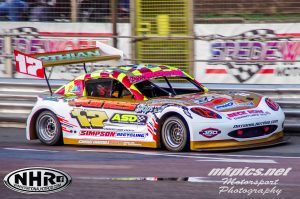
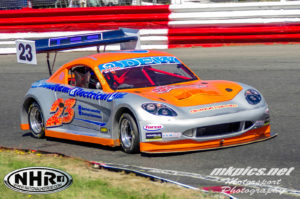
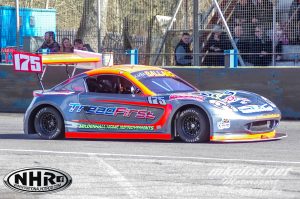
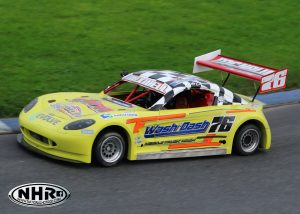
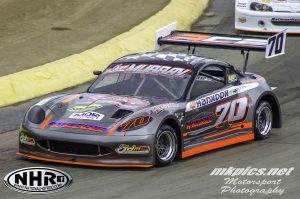
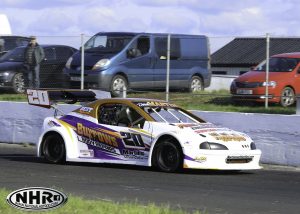
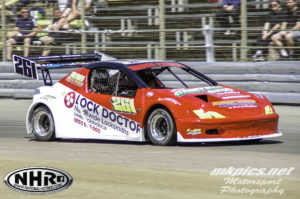
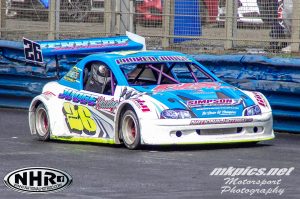
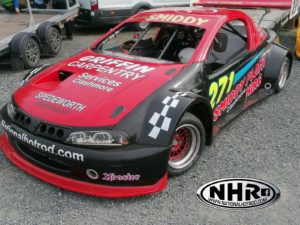
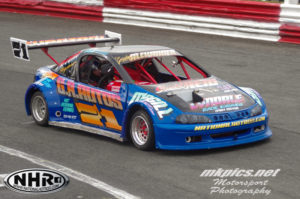
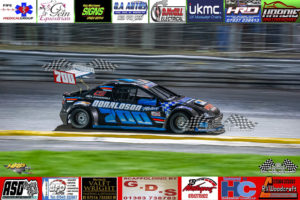
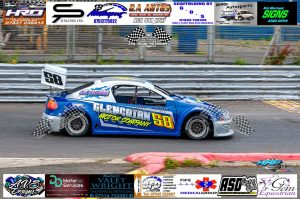
THE CARS. Today’s National Hot Rods, whilst outwardly resembling contemporary “hot hatch” road cars, are in fact purpose-built racing machines. More akin to Touring Cars in construction than road cars, they consist of a full tubular steel spaceframe on which are mounted tough kevlar panels in an exaggerated, lowered-and-widened customised style. Featuring full spoilers and other aerodynamic aids, some of the most popular styles of body are Renault Clio Williams, Audi TT, Fiesta XR2, Peugeot 206 GTi, VW Corrado, Opel Corsa GSi, Ford Focus and Mitsubishi Colt. Naturally they run full race-specification suspension and shocks on fat, slick, control US Hoosier tyres, and designated wet weather rubber. Whilst any 2.0l 8V engine can be developed for use in Nationals, the popular engines of choice are the newer 16V GM, Ford Zetec, VW and Peugeot blocks. A comprehensive rule book governs these 235+BHP beasts.
THE TRACKS. Although there are many oval tracks, NHRPA National Hot Rods can only be seen at the very best of them. Nationals, with their full race set-ups, tyres and massive power outputs, demand the very best surfaces combined with long wide straights and bends. The formula travels in each sanctioned nation as a “circus”, headlining fixtures at premier tracks. The season-long World Qualifying Series takes in these venues in each nation, plus there are international championship events and big Rod weekenders. National Hot Rod racing is presently sanctioned in England, Ireland, Northern Ireland, and affiliated in Belgium and Holland. For fixture details see above
THE SPECTACLE. Nationals - the fastest, breathtakingly awesome oval motorsport spectacle our side of the Atlantic. Twenty-five 235+BHP Gladiators, in a thundering 1/4 mile arena. How is so much power so skillfully controlled in racing combat in so tight a confine? Unbelievable! Come and see it - you’ll wonder why you haven’t been before, and return for more!... |